
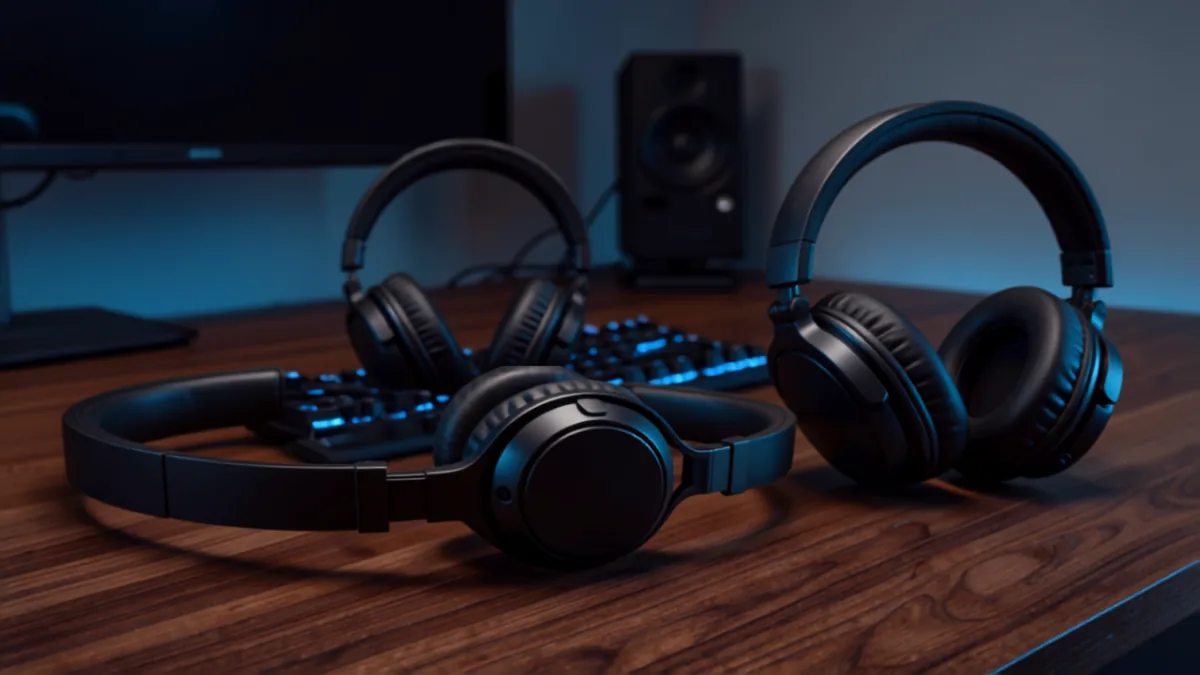
Best Gaming Headsets 2026/27: A No-Hype Buying Guide
Seven headsets, seven different jobs. Each pick below states who it is for, what it costs, and the specific reason you might not want it.
The short answer
If you only read one block, read this one. Full reasoning for every pick is further down.
Methodology
How we graded these headsets
The RigGrade Score is an aggregated rating, not a lab measurement. Each product is assessed against six fixed criteria — performance, reliability, compatibility, comfort, value, and ease of use — and the six results are combined into a single score out of 10. Performance draws on verified manufacturer specifications and recognized independent test results. Reliability draws on recurring patterns in user feedback rather than isolated complaints. Compatibility reflects the platforms buyers actually own: PC, PlayStation, Xbox, Switch, and mobile. Because the same six criteria apply to every category on the site, a 9.0 headset and a 9.0 mouse represent comparable confidence, not comparable hardware. The score is an editorial judgment built on sourced facts. It is not a measurement, and we mark any claim we could not verify independently instead of presenting it as established.
Two things this guide deliberately does not do. It does not rank by brand reputation, and it does not treat a higher price as evidence of a better product — you will find a $600 headset near the bottom of this list for exactly that reason.
Before the list
What actually matters in 2026
Most headset marketing highlights the specs that are cheapest to advertise. The three factors below change your experience far more than driver diameter or an RGB ring.
Your microphone is the spec you will notice least and your team will notice most
You never hear your own microphone during a match. Everyone in your squad hears it constantly. It is also the component manufacturers cut first to protect a price point, which is why two headsets with identical driver specs can sound completely different to the people you play with.
Detachable boom microphones generally outperform the small built-in arrays used on lightweight wireless models. That is a physical constraint, not a brand failing: a boom puts the capsule near your mouth, so it captures more voice and less room. If you play with a team, communicate for work, or stream, treat microphone quality as a primary criterion rather than a bonus. Polar patterns, boom placement, and the Bluetooth profile problem that quietly ruins voice quality are covered in Gaming Headset Microphone Quality Explained.
The latency argument is mostly settled
A 2.4 GHz gaming headset is a wireless headset that connects through its own dedicated USB receiver rather than through Bluetooth. This is the distinction that matters for gaming, and the frequency label alone does not explain it. A 2.4 GHz connection typically polls far more often than Bluetooth — often near 1000 Hz against roughly 125 Hz — and it runs on a dedicated channel instead of sharing a congested band with Wi-Fi, phones, and other peripherals. That combination, not the frequency itself, is why 2.4 GHz is the better choice for fast-paced games. Current flagship models are rated as low as 10 ms of wireless latency, which is below the threshold most players can detect. Bluetooth remains useful for phone calls, music, and travel, but it was never designed for competitive gaming and still adds noticeable delay on many devices.
The practical consequence: in 2026, choosing wired purely to avoid latency is usually the wrong reason. Choose wired to save money or to stop charging things. We break the full decision down in Wired vs Wireless Gaming Headset: Which Should You Buy?.
Weight decides whether you finish the session
Comfort is the criterion buyers underrate most and regret fastest. A headset that feels fine in a shop feels different three hours into a raid. Weight is the single most useful proxy: the lightest model in this guide is 165 g and the heaviest is 560 g — a difference of more than three times.
Weight alone does not decide comfort, though. Clamp force, headband design, ear-cup depth, and cushion material all matter, and a well-balanced heavy headset can beat a poorly balanced light one. But once you pass roughly 400 g, the headband has to work much harder to stay comfortable, and few designs manage it for a full evening.
The list
Seven headsets, seven different jobs
Ordered by RigGrade Score. The score reflects how well each headset does the job it is designed for, so a $50 wired model can legitimately outscore a $600 flagship on value and ease of use.
The Maxwell 2 is the pick when audio quality is the point rather than a feature. Its 90 mm planar magnetic drivers cover a 10 Hz–50 kHz range, and reviewers consistently describe it as one of the clearest wireless gaming headsets available for positional information, environmental detail, and dialogue. It handles music properly too, which very few gaming headsets do.
Battery life is the other standout: 80+ hours rated, with fast charging that returns about 24 hours of playback from a 20-minute charge. In practice that means you stop thinking about charging entirely, which is the real benefit — not the headline number.
Built for competitive FPS rather than general entertainment, and it shows in the tuning: the emphasis is on footsteps, reloads, and directional cues rather than cinematic bass. Razer rates the wireless connection as low as 10 ms, which puts the wired-versus-wireless latency debate to rest for this model, and the headset ships with per-game EQ profiles aimed at specific shooters.
One honest note on weight: published figures disagree. Reviewers report roughly 320 g in some tests and around 360 g in others. We have not weighed a unit ourselves, so treat it as “in the 320–360 g range” and heavier than a typical esports headset either way.
The most consistently recommended headset under $50, and the one we would hand to someone who just wants this decision to be over. The 50 mm drivers deliver a fuller low end than the 40 mm units common at this price, DTS Headphone:X adds usable spatial processing, and the swivel-to-mute microphone removes the most common source of embarrassing voice chat accidents.
It is also one of the lighter wired headsets in its bracket, which matters more than any spec on this line for a headset you will wear all evening. If this is your budget ceiling, four more models worth considering are in Best Gaming Headsets Under $50.
The feature that justifies this entry is the swappable battery system: one pack charges in the base while the other is in the headset, so the headset never has to stop. For anyone who has had a wireless headset die twenty minutes into a session, that design solves the actual problem rather than advertising a bigger number.
It also supports LDAC for higher-quality Bluetooth streaming and Hi-Res playback over USB, which makes it more useful outside gaming than most headsets at this price.
At 165 g this is the lightest headset in the guide by a very large margin, and it is the one most likely to disappear on your head during a long session. It carries both a Lightspeed 2.4 GHz connection for low-latency gaming and Bluetooth for a phone, which is unusual at this price.
It is also the sensible entry point into wireless. If you are unsure whether wireless is worth it for how you actually play, this answers the question without committing $250.
The Nova 5 exists for one specific reader: someone who wants a single headset for gaming and for a phone. It quick-switches between a 2.4 GHz connection and Bluetooth 5.3, and the companion app supplies per-game audio presets that are genuinely useful if you play a lot of different titles.
Be precise about what “dual wireless” means here, because the marketing rarely is. The Nova 5 switches between the two connections. It does not run both at the same time, so you cannot sit in party chat on the console and take a phone call simultaneously. Very few headsets truly combine both, and you should verify that specific behavior on any model that advertises dual wireless.
This headset is genuinely well made. The aluminium construction is a real step up, and in independent comparisons its active noise cancelling attenuates low-bass noise noticeably better than the Stealth Pro II — a measurable gap, not a marketing claim.
The problem is the price. At $600 it costs nearly twice the Stealth Pro II, and outside ANC performance and finish the practical gap is small, while the Stealth Pro II lasts longer on battery. Our value criterion is what pulls this score down to 7.0 — a low score here is not a claim that the hardware is bad, it is a claim that most buyers should not spend this.
Budget
How much should you actually spend?
The realistic sweet spot for a gaming headset in 2026 is between $50 and $100. Below $50 you are buying a competent wired headset with a decent microphone and no extras. Between $50 and $100 you add either genuine wireless freedom or a meaningful jump in sound and comfort, and this is where most players should stop. Between $100 and $250 you buy build quality, longer battery life, better microphones, and software features. Above $250 you are paying for planar drivers, active noise cancelling, aluminium construction, and premium finish — real engineering, but with clearly diminishing returns for the average player. Spending more does not fix the two things that actually ruin a headset purchase: poor comfort for your head shape, and buying a model your platform does not fully support.
Compatibility
Check your platform before you pay
This is the mistake most likely to turn a good headset into an unusable one. Xbox, PlayStation, PC, Nintendo Switch, and mobile devices do not all accept the same wireless receiver or the same feature set, and a headset family name tells you almost nothing — the Maxwell 2 alone ships in separate PlayStation and Xbox editions at different prices.
FAQ
Questions buyers actually ask
Is a wired or wireless gaming headset better in 2026?
Neither is universally better. Wired costs less, never needs charging, and has no batteries to age. Wireless removes the cable and, over a 2.4 GHz connection, no longer carries a latency penalty most players can detect. Choose based on whether the cable is an actual problem at your desk — the full breakdown is in our wired vs wireless guide.
How much should I spend on a gaming headset?
Between $50 and $100 for most players. Under $50 gets a solid wired headset. Above $250 buys real engineering — planar drivers, ANC, metal construction — but the improvement per dollar drops sharply, and no amount of money fixes a headset that does not fit your head.
Does 2.4 GHz wireless really have no lag?
It has latency, but current flagship models are rated as low as 10 ms, which is below what most players can perceive in normal play. The advantage comes from the dedicated receiver and a polling rate near 1000 Hz against roughly 125 Hz for Bluetooth — not from the frequency label itself.
Are expensive gaming headsets worth it?
Sometimes, and less often than the pricing suggests. The $600 Arctis Nova Elite in this guide is well built and has the strongest ANC here, but a $349 alternative lasts longer on battery and covers most of the same ground. Spend at the top only when you can name the specific feature you are buying.
Do I need a boom microphone?
If you play with a team, communicate for work, or stream, yes. A boom places the capsule near your mouth, so it captures more voice and less room noise than the small built-in arrays used on lightweight wireless models. If you play alone, it barely matters.
Will one headset work on PC, PlayStation, Xbox and Switch?
Rarely without compromises. Xbox in particular uses its own wireless system, and many headsets ship in separate platform editions. Check the exact model against the manufacturer’s platform support page before buying, and never assume a USB receiver carries across consoles.
Recap
All seven, side by side
| Headset | Best for | Price | Score | Main reservation |
|---|---|---|---|---|
| Audeze Maxwell 2 | Overall sound quality | $329 | 9.0 | 560 g — heavy |
| Razer BlackShark V3 Pro | Competitive FPS | $249 | 8.5 | Overkill for casual play |
| HyperX Cloud Stinger 2 | Value | Under $50 | 8.3 | Wired only |
| Turtle Beach Stealth Pro II | Uninterrupted wireless | $349 | 8.2 | Build quality criticized |
| Logitech G435 | Budget wireless, low weight | ~$50–80 | 7.8 | No boom microphone |
| SteelSeries Arctis Nova 5 | Phone plus gaming | Mid-range | 7.6 | Switches, does not combine |
| SteelSeries Arctis Nova Elite | Maximum ANC | $600 | 7.0 | Price against alternatives |
Sources & Methodology
How this guide was prepared
This is an aggregated buying guide, not a lab test. RigGrade did not physically test the products named above during the preparation of this version, and no manufacturer supplied hardware, payment, or editorial input.
Specifications were checked against manufacturer documentation and recognized independent reviews at the time of writing. Where published figures disagree — the weight of the Razer BlackShark V3 Pro is the clearest example in this guide — both figures are reported rather than resolved in favour of the more attractive one. Prices are list prices at the time of writing and move constantly; verify before buying.
RigGrade Scores are editorial judgments derived from the sourced facts against our six published criteria. They are not measurements. See How We Grade for the full method and our Editorial Policy for how we separate verified fact from opinion.
Reference sources
- PC Gamer — Audeze Maxwell 2 review (drivers, battery, clarity assessment)
- Tom’s Hardware — Audeze Maxwell 2 review (weight, dual-device behaviour, pricing)
- SoundGuys — Turtle Beach Stealth Pro II review (build quality reservation, battery system)
- RTINGS — Arctis Nova Elite vs Stealth Pro II comparison (ANC attenuation gap, battery comparison)
- SoundGuys — Razer BlackShark V3 Pro review (FPS tuning, reported weight)
- Razer — BlackShark V3 Pro official product page (latency rating, driver and ANC specs)
- Turtle Beach — 2.4 GHz vs Bluetooth headsets (polling rate and interference explanation)
- RTINGS — The 6 best gaming headsets of 2026 (cross-check on category picks)
Editorial and affiliate disclosure
Rankings, scores, and reservations above are RigGrade’s editorial judgment. No brand paid for placement, and no entry was added or removed in exchange for anything. This guide is the hub of our gaming headset cluster — see the full gaming headsets category for the supporting articles.
Where this page carries affiliate links in future, each one will be clearly identified as such and will never influence a score or a verdict. Our full terms are in the Affiliate Disclosure, and more about who writes this on About RigGrade.